On Martyrdom and Celebrating Resistance
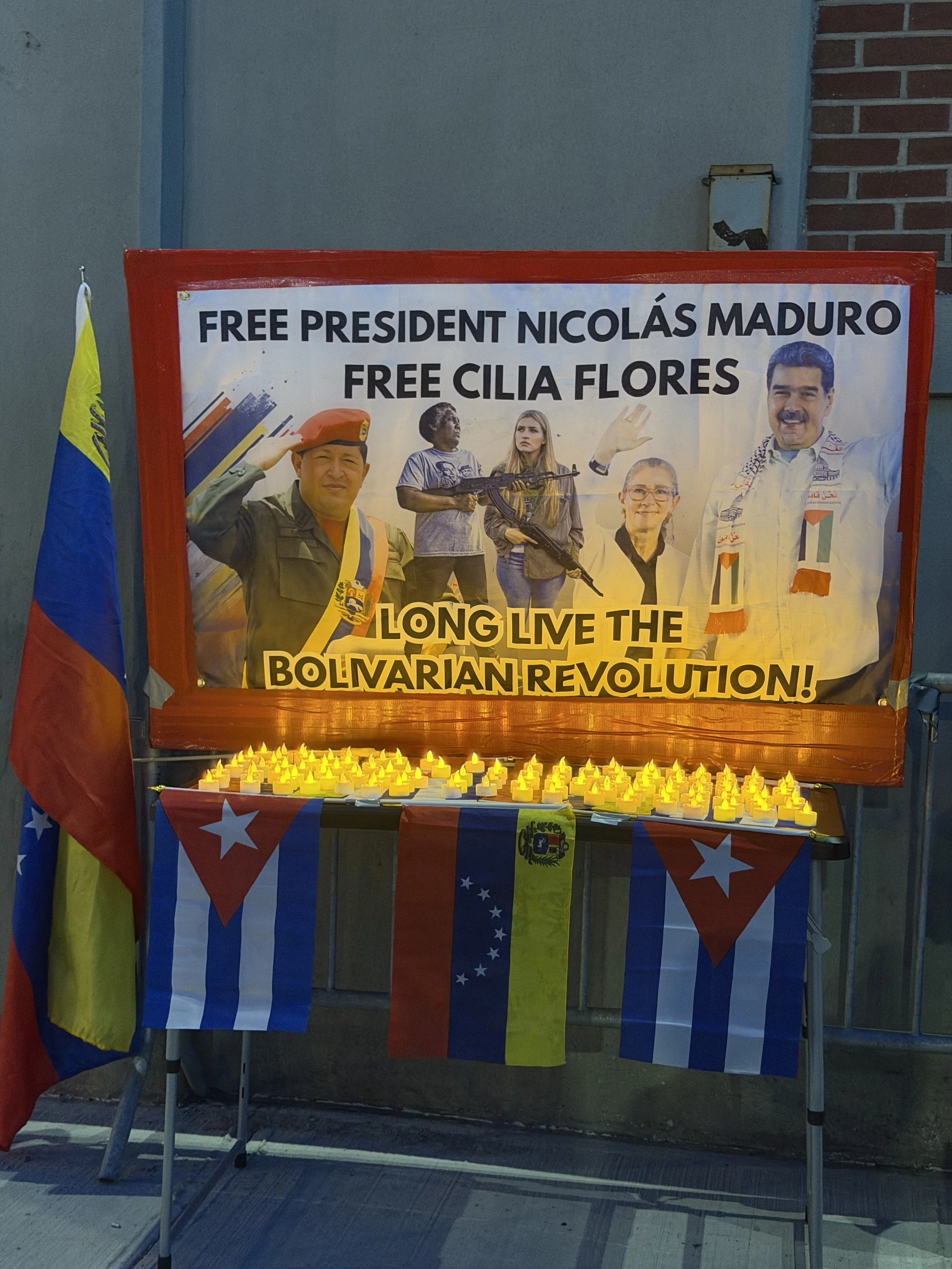
On April 3, 2026 in Brooklyn, a Good Friday vigil organized by the Black Alliance for Peace gathered outside the Metropolitan Detention Center to honor the more than 100 Cuban and Venezuelan martyrs killed in the January 3, 2026 U.S. attack on Caracas and to demand freedom for kidnapped President Nicolás Maduro and First Lady Cilia Flores.
The following are remarks by Che from Bronx Anti-War at the vigil.
“I know we’re here to honor the Cuban and Venezuelan martyrs who sacrificed their lives defending Venezuela’s sovereignty. That is, and should be, a somber thing. Whenever someone leaves us—leaves the struggle—that is a loss.
But we also have to understand that in many parts of the world, martyrdom is a great honor. It is what many people actually strive for: to live and die fighting injustice and fighting US imperialism. There is no greater honor than dedicating your life to that struggle.
I want to thank you all for being out here today, because showing up like this is part of that same tradition.
Often, when we talk about solidarity with Venezuela, Cuba, Iran and other countries under attack, the focus is on the death and destruction: the bombings, the sanctions, the bodies pulled from the rubble. And we need to name that violence.
But we also have to recognize something else: US imperialism is in decline. The US empire is not going to live forever. Right now, there is real, material decolonization happening across the world.
As revolutionaries—and I think that’s what we consider ourselves here—we can’t only look at the horror the US wants us to see. The US government wants us to focus only on the images of devastation. They want us to feel nothing but despair when we see those videos of dead bodies pulled from the ruins.
So why should we give the US exactly what it wants?
They don’t want you to look at Venezuela’s resistance. They don’t want you to see the millions of people in the streets every single day. They don’t want you to see Indigenous and African people holding rifles, speaking directly into the cameras, saying they are ready for the Yankees to come—because they are prepared to defend their country. Being armed is power: power to defend yourself, your land, and your revolution against the empire.
They don’t want you to see Cuba’s endurance through decades of blockade, or Iran and West Asia fighting back—US universities closing their doors there, US companies being forced out, infrastructure like data centers being struck. These are signs of an empire that does not have the control it once had.
All of this is connected.
Venezuela, Cuba, Iran, and many other countries are anti‑imperialist nations united by a common struggle, despite all their differences in geography, religion, language, and culture. When something positive happens in one part of that front—when there is a decolonizing victory in West Asia, when US influence is pushed back anywhere—that struggle and that momentum will reach Venezuela, will reach Cuba. These victories travel.
So we cannot only mourn. We must also recognize the power, determination, and victories of the people on the ground.
If we call ourselves revolutionaries, we have to carry revolutionary optimism. That doesn’t mean ignoring the pain or minimizing the loss. It means believing, based on material reality, that empire is weakening and that people’s struggles matter and can win.
And in that spirit, we remain optimistic that President Nicolás Maduro and First Combatant Cilia Flores will be freed—and I honestly believe it may happen sooner than many expect.
But that will not happen on its own. It depends on us:
keeping their names alive,
keeping their cases in the news cycle,
continuing to show up in the streets,
and standing firm in unconditional solidarity with the Cuban, Iranian, Palestinian, Lebanese and Venezuelan people.
So as we honor the martyrs today, don’t only remember how they died—remember what they fought for and how they lived. Honor them not just with grief, but with a commitment to follow in their footsteps.