Pinkwashing Iran: How the U.S. Weaponizes Women & Queer Rights to Serve U.S. Imperialism
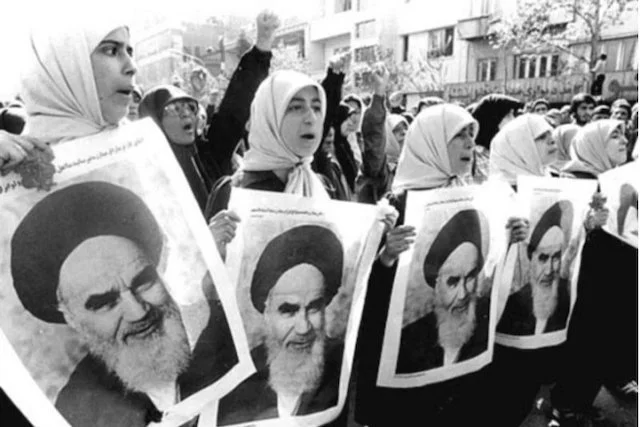
Iranian women played a pioneering role in 1979 Revolution
The U.S. Uses “Human Rights” as a Cover for Regime Change
For over seven decades, the U.S. and Britain have targeted Iran not because of women or queer rights violations, but because Iran refuses to be subordinated to Western domination. The 1953 CIA–MI6 coup set the template: overthrow or punish any nation that asserts sovereignty, controls its own resources, or resists U.S.–Zionist imperialism in the region.
Modern US-led Western imperialism hides this agenda behind the language of “human rights.” Washington and its allies selectively weaponize women’s and LGBTQ struggles to justify sanctions, delegitimize governments, and engineer internal destabilization — all while claiming humanitarian concern. This is not solidarity. It is an imperial psychological operation designed to manufacture consent for war, sanctions, and regime change.
Mahsa Amini Was Weaponized as a Regime-Change Psychological Operation
The West built its entire regime-change narrative on one case — Mahsa Amini — not because they cared about her, but because her death could be instantly weaponized. Within hours, Western governments, U.S.-funded NGOs, and CIA-aligned diaspora “journalists” declared she was murdered, despite the absence of evidence and before any medical report was even reviewed. Those who first spread the “morality police beating” narrative had direct links to CIA training and foreign intelligence networks — because the point was not truth, it was to create a psychological trigger for destabilization.
Western media ignored CCTV footage of her collapsing, ignored the forensic and coroner reports, ignored the official human-rights investigation, and ignored every contradiction — because a factual account would not serve the regime-change operation. Instead, they manufactured a martyr and flooded social media with coordinated messaging, while Western-funded separatist terrorist cells used the chaos to launch armed attacks, kill civilians, and target police — including plots to assassinate Amini’s own father to prolong the crisis.
The hypocrisy is staggering: Israel’s ambassador held up Amini’s photo at the UN while Israeli forces sniped and assassinated Shireen Abu Akleh in plain view of the world. The U.S., which claims Iran “kills its own women,” is the same empire whose police kill women daily, whose wars have used rape and torture from Palestine to Afghanistan to Puerto Rico, and whose sanctions kill Iranian women by cutting off medicine, cancer treatment, and basic rights to life.
Amini’s death was tragic — but the Western response was not compassion, it was opportunism. A psychological operation designed to manufacture consent for sanctions, intervention, and the “Women Life Freedom” regime-change project. The empire that kills women globally declared itself the defender of Iranian women — because her story was useful. And that is the clearest sign of all that this was never about Mahsa Amini, but about overthrowing Iran’s government.
“Women, Life, Freedom” Is a Western-Backed Regime-Change Project
Women, Life, Freedom (WLF) was not a spontaneous feminist uprising of the Iranian masses. It is a pro-Western, elite-driven political project, centered in the diaspora, heavily amplified by U.S.-funded NGOs, and aggressively promoted by Western governments seeking regime change in Iran—not liberation for Iranian women.
WLF rhetoric resonates primarily with Westernized middle- and upper-class Iranians who identify ideologically with Europe and the United States. It does not represent the vast majority of Iran’s working class, rural communities, ethnic minorities, or poor women whose material gains since the Revolution came from internal struggle—not Western-style “freedom” campaigns. The West amplified WLF precisely because its politics align with U.S. strategic interests, not Iranian women’s needs.
WLF’s slogans erase decades of women’s organizing in Iran, ignore the advancements secured since 1979, and collapse an entire society into a single regime-change narrative. This is why the movement gained traction in Manhattan, Los Angeles, Berlin, and Paris, but not among Iranian factory workers, teachers, rural women, or the poor—those who have the most to lose from U.S. sanctions and Western intervention.
The mass of Iranian women do not see their liberation in Western-backed campaigns. They know their futures are threatened far more by U.S. sanctions, economic warfare, and the constant threat of bombing than by the slogans of elite diaspora activists. WLF is not a movement for Iranian liberation—it is a regime-change vehicle constructed by and for Western power, used to justify more war on Iran while claiming humanitarian concern.
Not All Diaspora Voices Represent Iran: Reactionary Elites Serve U.S. Imperialism
After the 1979 Revolution, the class that benefited from U.S. domination — monarchists, capitalists, Westernized elites, intelligence collaborators, and those tied to the Shah's dictatorship — did not simply “flee Iran.” They were absorbed, welcomed, and politically weaponized by the United States and Europe. Just like the Cuban gusanos after 1959, these exiles were invited to relocate to the West precisely because their class interests aligned with imperialism, not with the masses who made the revolution.
The U.S. understood immediately that these former elites could serve as a permanent exile opposition, providing the cultural credibility and “Iranian authenticity” empire needed to attack the new revolutionary government. They were funded, platformed, and integrated into Washington’s regime-change infrastructure — from think tanks to media to “human rights” NGOs. Their role has always been to advocate for sanctions, coups, and foreign intervention under the guise of “saving” Iran.
This is the same pattern seen in Cuba, where Washington cultivated a wealthy, anti-socialist exile class in Miami to function as an auxiliary arm of U.S. imperial policy against the Cuban people. In both cases, the West elevates the voices of exiled elites — not because they represent their homelands, but because they represent the politics of the collaborator class that lost power when the people overthrew U.S.-backed dictatorships.
Today, reactionary Iranian diaspora elites in the West continue this role. They weaponize their identity to legitimize Western lies, advocate for war and sanctions, and claim their pro-imperialist politics reflect the will of the Iranian people. But identity is not neutrality. These voices speak for the class that sided with empire, not for Iran’s workers, women, students, or poor — the very people crushed by sanctions.
The only Iranian voices we uplift are those who defend their nation’s sovereignty, oppose U.S.–Zionist domination, reject sanctions, and stand with the Axis of Resistance and the anti-imperialist struggle across West Asia.
Iranian Women’s Gains Came from Internal Struggle — Not Western “Liberation”
Iranian women have won enormous gains since the revolution — gains achieved through their own internal struggle, not delivered by Western powers. They organized to secure universal literacy, access to higher education, widespread childcare, paid maternity leave, and entry into the country’s scientific and professional sectors even under war and sanctions. These achievements reflect the capacity and agency of Iranian women, not Western “feminist rescue” narratives.
At the same time, Iranian women — like women everywhere — still have a long road toward full liberation. But one thing is unmistakably clear: no society can advance women’s liberation while being strangled by U.S. sanctions, economic warfare, and constant threats of bombing. The U.S. empire that claims to “save” Iranian women is the same force blocking medicine, destroying the economy, and pushing Iran toward instability — conditions that always hit women first and hardest.
If people in the imperial core truly care about Iranian women, the first step is simple: End the sanctions. Stop the siege. Stop the war plans. Let Iranian women build their future without the U.S.-Zionist boot on their neck.
Queer & Trans Rights in Iran Advance Through Sovereignty, Not U.S. Intervention
Queer and trans people in Iran have won meaningful gains through their own internal struggle, within their own cultural, religious, and political context — not through Western intervention and certainly not through U.S. “liberation.” Iran has developed systems for gender-affirming care, legal gender recognition, and HIV harm-reduction programs even under the violence of sanctions and constant foreign intervention. These are concrete, material advancements built inside a society fighting for sovereignty, not “liberation” handed down by the West.
At the same time, queer and trans Iranians — like queer and trans people everywhere — still face challenges and contradictions. But no progress can deepen under siege. U.S. sanctions devastate public health systems, block medicine, destroy infrastructure, and create the kind of economic crisis that always hits the poorest and most oppressed sectors first — and queer and trans people are overwhelmingly part of those sectors. When healthcare collapses, when jobs disappear, when medicine becomes scarce, it is the marginalized — including queer and trans Iranians — who bear the brunt. The West that claims to “save” queer Iranians is the same empire whose wars, torture regimes, and occupations have used sexual humiliation and anti-queer violence as deliberate weapons.
Queer liberation cannot be detached from anti-imperialist struggle. Iran’s queer community will not be liberated through Western bombs, Western propaganda, Western NGOs, or Western pinkwashing campaigns that serve the interests of empire. Their victories so far — and their future ones — come from within Iran’s own social fabric and political movements, on their own terms, and in their own unique forms of struggle.
If those of us in the imperial core care about queer and trans Iranians, our task is not to go along with the official U.S. State Department narratives — it is to fight the empire we live inside, end the sanctions, stop the demonization campaign, and dismantle the machinery of the U.S. war machine that makes liberation for anyone, anywhere impossible.
The Hijab Is Exploited by the West to Justify Sanctions and Intervention
In Iran, the hijab is not the one-dimensional symbol of “female oppression” presented by Western media. Iranian women’s dress varies widely across communities — Muslim, Christian, Jewish, Armenian, Kurdish, Azeri, rural, urban, conservative, secular — each with their own norms and expectations. Clothing in Iran reflects culture, class, religion, history, and regional identity — not a simple top-down state caricature.
The West collapses this rich diversity into a single Orientalist narrative to claim that Iranian women live under uniquely repressive conditions. This distortion deliberately erases the material gains Iranian women have made, the agency they exercise inside their own country, and the ongoing internal debates Iranians themselves have about law, religion, and social change. Those debates belong to Iranians — not to the United States.
Most importantly: the hijab is not what oppresses Iranian women — U.S. sanctions and bombs do. No society can resolve internal contradictions or advance women’s liberation under economic warfare, medicine shortages, political sabotage, and constant threats of bombing. Western powers weaponize the hijab narrative to justify the very imperial policies that harm Iranian women the most.
If people in the imperial core truly care about Iranian women, the task is not to police their clothing — it is to end the sanctions, stop the intervention, and let Iranian women shape their own future without empire strangling their society.
Sanctions Are Economic Warfare That Block All Paths to Liberation
Sanctions are not “diplomacy” or “pressure.” They are a form of warfare. Sanctions block medicine, food imports, industrial parts, infant formula, aircraft components, cancer treatment drugs, insulin, and basic materials needed for daily life. They deliberately collapse public health systems, destroy infrastructure, and create shortages that push societies into crisis. And as with every U.S. economic war — from Iran to Cuba to Venezuela — sanctions never touch the elite. They crush the poor and working class first, and within those groups the most marginalized — including women, queer, and trans people — suffer the most.
If people understand why the blockade on Cuba is immoral and must be lifted, they should feel exactly the same about sanctions on Iran. The logic is identical: sanctions starve, isolate, and sabotage sovereign nations so the U.S. can force political outcomes it could never win democratically. Cuba’s shortages are not a “failure of socialism” — they are the result of a U.S. siege. Iran’s difficulties are not “proof of oppression” — they are consequences of the same imperial chokehold.
Sanctions make every internal struggle harder. No liberation — not women’s liberation, not queer liberation, not class liberation — can unfold under economic warfare. How can a society debate cultural or legal issues when the empire is blocking medicine, destroying their economy, and threatening to bomb the country? How can poor and working-class Iranians fight for improvements when they are forced to spend their lives navigating shortages engineered in Washington?
The West weaponizes the hijab and “human rights” narratives to justify the very sanctions that suffocate Iranian women, queer people, and the entire working class. The people most harmed by sanctions are always the ones the West claims it wants to “save.”
If you demand the blockade on Cuba be lifted, then consistency demands the same for Iran. The struggle is the same: End the sanctions. End the siege. Let oppressed people breathe so they can fight their own fights.
Iran Is Targeted Because It Supports Palestine and is Anti-Imperialist
Iran is demonized not for “human rights,” but because it is the backbone of the Axis of Resistance — the central force providing material, logistical, and military support to the Palestinian resistance. Iran’s revolution transformed it into a sovereign power committed to resisting U.S.–led imperialism and aiding all peoples fighting oppression, with Palestine at the forefront.
Iran unifies and equips the entire Axis — including Hezbollah, Hamas, Islamic Jihad, Ansar Allah, and Iraqi resistance forces — through training, intelligence coordination, and advanced military capabilities that have repeatedly weakened Israel’s occupation and exposed the limits of U.S. power.
It is Iran’s material, operational, and ideological commitment to Palestinian liberation — not Western myths about women or queer rights — that makes it a primary target of U.S. sanctions, propaganda, and war.
Real Solidarity in the U.S. Means Fighting Our Own Empire — Not Lecturing Iran
Iran is a sovereign nation with its own political debates, contradictions, and paths toward liberation. Those debates belong to Iranians — not to Westerners living in the heart of the empire that sanctions, bombs, and tries to overthrow their government. Our responsibility is fundamentally different, because the U.S. government is the aggressor and primary oppressor of Iran.
What We DO as anti-imperialists in the U.S.:
• Fight the empire we live in — oppose sanctions, oppose military threats, oppose CIA/NED intervention, oppose regime-change psyops like “Women Life Freedom.”
• Expose Western propaganda that portrays Iran as “backwards,” “oppressive,” or uniquely violent — narratives used to justify economic and military warfare.
• Challenge U.S. media lies about Iranian society, women, queer people, and culture — lies that erase Iran’s real achievements and agency.
• Defend Iran’s sovereignty, its right to self-determination, and its position within the Axis of Resistance.
• Demand the sanctions be lifted, with the same consistency people demand an end to the blockade on Cuba — because sanctions kill.
• Build political education in our communities and movements about how imperialism manufactures crises to justify intervention.
What We Do NOT Do:
• We do NOT tell Iranians how to run their society, shape their culture, or resolve their internal debates.
• We do NOT export Western liberal “feminism” or NGO politics into a country our government is actively attacking.
• We do NOT center ourselves or pretend to “speak for” Iranian women, queer people, workers, or youth.
• We do NOT reproduce liberal narratives that claim Iran’s contradictions are proof it should be sanctioned or toppled.
Why This Matters:
Iran is targeted not because it oppresses women or queer people, but because it resists U.S. domination, stands with Palestine, and has built social gains outside Western control. Our role is not to judge Iran while our government tries to strangle it — our role is to break the stranglehold.
The task for people in the U.S. is simple: Hands off Iran. End the sanctions. Reject the propaganda. Fight the empire at home. Let Iranians resolve their future — free from U.S. imperial violence.
Additional Resources
Sanctions
What Are Sanctions? - sanctionskill.org
U.S. Sanctions on Iran - Congress.gov
Iran Sanctions - Ofac.treasury.gov
Post 1979 Advancements
Iran – 41 years after the revolution of 1979 - CGTN
Iran's Islamic Revolution: A Brief History - youtube.com
Women & Queer/Trans Rights
Anti-Iran protest misdirects LGBT struggle - workers.org
Iranian women played a pioneering role in 1979 Revolution - english.khamenei.ir
Status of women in Iran – workers.org
Women’s education before and after the Islamic Revolution: A Comparative study - english.khamenei.ir
Achievements of women after the Islamic Revolution - tehrantimes.org
More advancements in Iranian society – workers.org
Weaponization of Women/Queer Rights by West
Iran and the Axis of Resistance - dissidentvoice.org
Against Imperial Confusion: Solidarity with Iran - youtube.com
The Media War Against Iran | Unmasking Imperialism Ep. 17 - youtube.com
In Defense of Iran | Unmasking Imperialism Ep. 101 - youtube.com
The Resistance Axis | Unmasking Imperialism Ep. 102 - youtube.com